
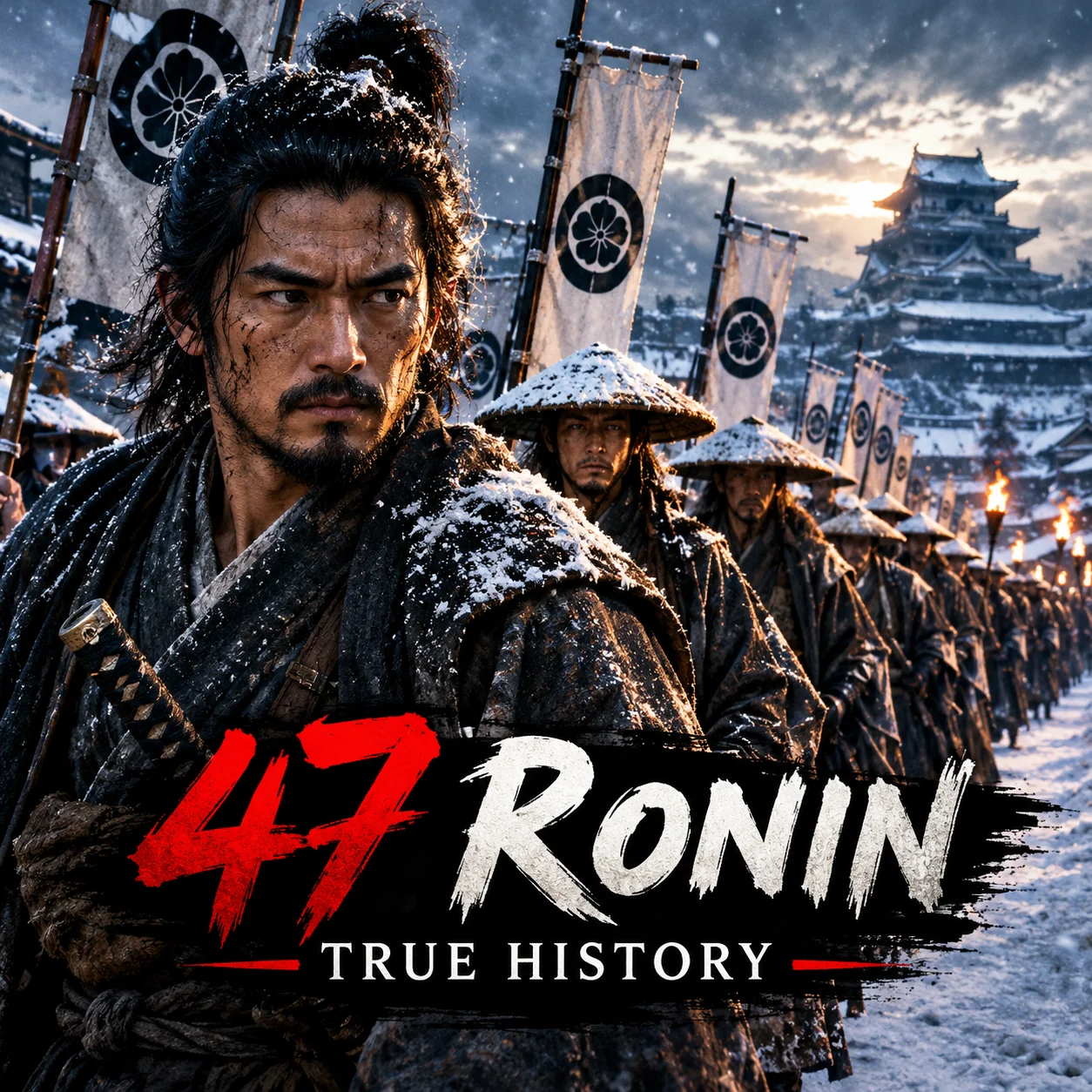
The 47 Ronin: True History of Japan’s Feudal Vendetta
The saga of the 47 Ronin stands as the definitive historical demonstration of feudal loyalty, tactical planning, and samurai devotion in Japanese history. Known formally in administrative records as the Genroku Akō Incident (Akō jiken), this bloody episode unfolded between 1701 and 1703 during the fifth Tokugawa shōgun’s reign. Far from a spontaneous act of vengeance, the authentic historical record reveals an intricate covert operation executed by seasoned administrators who risked total lineage eradication to satisfy their martial obligations.
Popular modern retellings frequently depict the retainers as ragged, wandering vigilantes driven purely by rage. Authentic archival records present a far more grounded reality of bureaucratic maneuvering, intelligence collection, and strict operational security. The 47 Ronin did not merely execute an armed assault; they navigated the rigid legal machinery of the Tokugawa shogunate while adhering strictly to the ethical tenets of their warrior caste.
The Corridor of the Pines: The Catalyst of 1701
The political crisis began in the spring of 1701 within the sprawling corridors of Edo Castle. Asano Naganori, the thirty-four-year-old daimyō of the coastal Akō domain, was appointed by the military government to receive imperial envoys sent from the Kyoto court. To instruct him in courtly procedures, the shogunate assigned Kira Yoshinaka, a senior master of ceremonial protocol (kōke).
Friction between the two officials surfaced almost immediately during state preparations. Kira considered Asano an uncouth provincial lord who failed to present suitable protocol gifts and customary bribes. Asano, in turn, viewed Kira as an extortionate court functionary who intentionally dispensed incomplete advice to humiliate him in front of visiting aristocrats.
On April 21, 1701 (the fourteenth day of the third lunar month), the dispute erupted into violence within the Matsu no Ōrōka (the Great Corridor of the Pines). Enraged by an insult, Asano unsheathed his short sword (wakizashi) and struck Kira twice across the forehead and shoulder. Castle guards intervened before a lethal strike could land. Drawing an edged weapon inside the shōgun’s administrative seat was a capital crime carrying mandatory execution.
[Matsu no Ōrōka Assault (April 1701)]
                  │
                  ▼
[Tokugawa Shogunate Judgments]
       │
       ├─► Asano Naganori: Immediate seppuku; clan lands forfeited
       └─► Kira Yoshinaka: Completely exonerated; zero official reprimand
                  │
                  ▼
[Dispossession of 300 Retainers] ──► Formation of the 47 Ronin Cadre
Shōgun Tokugawa Tsunayoshi acted with swift, unilateral severity. Dispensing with the customary investigative tribunal to assess mutual provocation (kenka ryōseibai), Tsunayoshi commanded Asano to commit ritual suicide (seppuku) before sunset. The shogunate confiscated Akō’s entire 53,000-koku rice revenue and reduced more than three hundred retainers to masterless wanderers (rōnin). Kira Yoshinaka escaped without censure, sparking immediate outrage among Asano’s loyal retainers.
Ōishi Kuranosuke and the Legal Fight for Akō Domain
When courier dispatches reached the provincial capital of Akō, the retainers split into volatile factions. Radical younger samurai demanded an armed siege against government commissioners, while conservative retainers favored unconditional surrender. Ōishi Kuranosuke, the domain’s principal elder (karō), assumed direct command of the crisis with absolute tactical composure.
Ōishi averted suicidal military rebellion by peacefully surrendering Akō Castle to shogunate commissioners in May 1701. He systematically distributed the domain’s treasury, repaid commercial debts owed to regional merchants, and established sustenance stipends for displaced samurai families. Beneath this façade of administrative cooperation, Ōishi entered into a private blood pact (renpanjō) with an inner circle of committed retainers.
The primary ambition of the 47 Ronin coalition was not immediate bloodshed. For over a year, Ōishi exhausted all legal avenues to petition the government to rehabilitate the clan under Asano’s younger brother, Asano Daigaku Nagahiro. The retainers sought permission for Daigaku to inherit the Asano lineage and preserve the clan’s ancestral samurai status.
In August 1702, the shogunate delivered its definitive verdict. The bakufu placed Asano Daigaku under permanent confinement with the primary branch of the Asano clan in Hiroshima, closing all administrative pathways for domain restoration. With legal remedies gone, Ōishi assembled his trusted retainers in Maruyama to confirm their final, irreversible objective: the assassination of Kira Yoshinaka.
Espionage, Logistics, and Tactical Infiltration
Executing a precision strike inside the military capital of Edo presented severe tactical challenges. The city maintained an extensive police grid, rigid gate curfews, and civilian surveillance networks designed to intercept armed dissidents. To ensure operational success, the 47 Ronin conducted a long-term urban intelligence operation under deep cover.
+------------------------------------------------------------------------+
|               URBAN RECONNAISSANCE AND INFILTRATION TACTICS            |
+------------------------------------------------------------------------+
| 1. STRATEGIC DECEPTION: Ōishi's public dissipation in Kyoto brothels   |
| 2. COVERT INFILTRATION: Retainers enter Edo disguised as urban laborers |
| 3. STRUCTURAL RECONNAISSANCE: Acquisition of Kira's mansion schematics  |
| 4. MATÉRIEL LOGISTICS: Procurement of concealed armor and silent tools |
+------------------------------------------------------------------------+
To distract bakufu informants and Kira’s personal bodyguards, Ōishi relocated to Yamashina near Kyoto. He spent months drinking openly in the Gion pleasure quarter, feigning total moral collapse and domestic indifference. Kira’s intelligence agents reported that Asano’s senior officer had descended into irredeemable depravity, prompting Kira to relax his defensive posture.
Simultaneously, small cells of retainers infiltrated Edo disguised as merchants, monks, and municipal laborers. Retainer Otaka Gengo used his literary training in classical haiku to enter refined cultural circles, eventually befriending a tea master who organized gatherings at Kira’s compound. Through this contact, the retainers learned that Kira would host a major winter gathering on January 30, 1703 (the fourteenth day of the twelfth lunar month).
Another operative, Maebara Isuke, established a dry-goods shop near Kira’s fortified estate in Honjo to monitor guard patterns. By commissioning carpenters who worked on the premises, the retainers obtained the architectural layouts of Kira’s private chambers. As detailed in the philosophical analysis of the [Internal Link: Bushido Code Eight Virtues], their covert preparations required total emotional detachment and extreme personal discipline.
The Winter Night Raid on Kira’s Compound
On the freezing night of January 30, 1703, heavy snow masked the streets of Edo. The 47 Ronin assembled at three designated safe houses across the city to don customized night-raid gear. They wore dark surcoats over concealed chainmail shirts (kusari katabira), iron-ribbed travel hats (jingasa), and white fabric armbands to identify comrades in darkness.
The strike force deployed into two tactical echelons to encircle the target estate:
-
The Front Gate Force: Commanded directly by Ōishi Kuranosuke, twenty-three retainers carried timber battering rams, scaling ladders, grappling cords, and pikes to force the main entry.
-
The Rear Gate Force: Commanded by Ōishi’s sixteen-year-old son, Ōishi Chikara, twenty-four retainers deployed composite longbows and matchlocks to intercept fleeing guards.
                            [ KIRA YOSHINAKA'S ESTATE ]
                                         │
        ┌────────────────────────────────┴────────────────────────────────┐
        ▼                                                                 ▼
[Front Gate Column: 23 Men]                                     [Rear Gate Column: 24 Men]
- Led by Ōishi Kuranosuke                                       - Led by Ōishi Chikara
- Breached courtyard with rams & ladders                        - Formed exterior containment line
- Cleared defensive corridors and quarters                      - Suppressed fleeing guards with arrows
At approximately 4:00 AM, Ōishi’s assault units breached the outer barricades. Ōishi dispatched written messages to neighboring estates owned by prominent daimyō, stating that the raiders were Asano retainers executing a private vendetta and that adjoining properties faced no danger. The neighboring lords remained strictly inside their compounds, refusing to intervene.
Kira’s garrison of roughly forty armed retainers mounted fierce, desperate resistance in narrow hallways and inner courtyards. Despite close-quarters melee against professional swordsmen, the 47 Ronin maintained tight tactical formations, using short spears to clear rooms methodically. After two hours of intense combat, Asano’s men neutralized Kira’s defensive guard without suffering a single fatality.
Search parties initially failed to locate Kira inside his primary bedchambers. A secondary search led retainers to an exterior storage shed packed with firewood and charcoal. When an operative pierced a hidden wall space with a spear, an armed defender lunged with a blade but was promptly disarmed.
The conspirators confirmed the target’s identity by the prominent facial scar Asano had inflicted twenty-one months prior. Ōishi treated the elderly official with strict formal deference, offering Asano’s original dagger and inviting Kira to perform seppuku. Kira remained petrified and refused to take the weapon. Recognizing his refusal, Ōishi decapitated him with the blade.
The Sengaku-ji March and the Judicial Dilemma
With their objective achieved, the 47 Ronin wrapped Kira’s head in white silk and departed the compound at dawn. Carrying their weapons in broad daylight, they marched across the center of Edo toward Sengaku-ji, the Zen temple where Asano was entombed.
Word of the coordinated strike spread through the capital with remarkable speed. Crowds of merchants, tradesmen, and samurai gathered along the route, cheering the retainers for their discipline and filial courage. At Sengaku-ji, the retainers purified Kira’s head at a courtyard well, laid it before Asano’s tomb, burned incense, and surrendered to the temple authorities.
[Target Neutralized at Dawn] ──► [Procession to Sengaku-ji] ──► [Surrender to Edo Magistrate]
                                                                          │
                                                                          ▼
                                                             [The Great Bakufu Debate]
                                                             - Ogyū Sorai: Protect Public Law
                                                             - Muro Kyūsō: Praise Martial Virtue
                                                                          │
                                                                          ▼
                                                             [Final Verdict: Honorable Seppuku]
                                                             (Executed across 4 Daimyo Mansions)
Ōishi sent two emissaries to the city magistrate, surrendering the contingent and requesting legal judgment. Shōgun Tsunayoshi and his highest advisers faced a profound institutional dilemma. The 47 Ronin had violated the imperial peace by staging an unauthorized military raid in the capital, an offense demanding execution as common outlaws. Yet the retainers had demonstrated supreme Confucian loyalty and military valor, qualities the shogunate championed.
Tokugawa scholars engaged in intense philosophical debate over the proper punishment. Political philosopher Ogyū Sorai argued that personal virtue could not override civic law, warning that pardoning vigilantism would destroy public order. Conversely, Confucian scholar Muro Kyūsō insisted that condemning filial warriors like common thieves would dishonor the foundational principles of the warrior class. As examined in tactical records of the [Internal Link: Battle of Sekigahara Tactics], the shogunate consistently prioritized social stability above personal martial initiative.
After forty-seven days of deliberation, Shōgun Tsunayoshi delivered his compromise decree. The state found the conspirators guilty of unlawful assembly and murder, but granted them the honorable death of seppuku instead of execution by decapitation.
On March 20, 1703 (the fourth day of the second lunar month), the retainers carried out their sentences across four separate daimyō residences. Each retainer performed the incision with flawless composure. Their remains were transported to Sengaku-ji and buried alongside their lord, where the graves remain an active pilgrimage site today.
Tactical Matériel of the Genroku Raid
The success of the assault rested on specialized tactical equipment designed for winter urban warfare. The retainers avoided heavy field plate in favor of flexible, silent gear.
+-------------------------------------------------------------+
|             ASSAULT FORCE TACTICAL EQUIPMENT AUDIT          |
+-------------------------------------------------------------+
| • Armor: Kusari katabira (chainmail concealed beneath coats) |
| • Helmets: Iron-reinforced jingasa with chin straps         |
| • Primary Arms: Cut-down yari (spears) and nagamaki blades  |
| • Sidearms: Matched daishō (katana and wakizashi pairs)     |
| • Utility Tools: Silent bamboo ladders, whistles, axes       |
+-------------------------------------------------------------+
Every piece of equipment fulfilled a defined operational role:
-
Concealed Armor: Lightweight chain vests (kusari katabira) offered protection against glancing blade slashes while permitting unrestricted movement inside cramped hallways.
-
Reinforced Helmets: Lacquered jingasa hats featuring hidden iron bands shielded retainers from thrown tiles and downward sword strikes.
-
Shortened Polearms: Cut-down spears allowed retainers to deliver fatal thrusts through sliding screens without their shafts snagging on low ceilings.
-
Signaling Systems: Copper whistles enabled unit leaders to coordinate building sweeps across separate wings of the compound without shouting.
Historical Reality vs. Theatrical Mythology
Within months of their deaths, the story of the retainers was transformed by the popular press and commercial theater. Puppet theater (bunraku) and kabuki playhouses adapted the vendetta into sweeping fictional dramas.
HISTORICAL GENROKU RECORD
├── Calculated legal campaign to restore Asano Daigaku
├── Covert urban reconnaissance and blueprint acquisition
├── Coordinated two-column raid using short spears and bows
└── Judicial compromise granting honorable seppuku

POPULAR THEATRICAL ADAPTATION (CHŪSHINGURA)
├── Spontaneous moral outrage over Asano's death
├── Romanticized wandering ronin enduring extreme poverty
├── Dramatic personal duels inside the estate
└── Defiant martyrdom against corrupt political authorities
Because the Tokugawa shogunate strictly prohibited depictions of contemporary political scandals, playwrights transferred the narrative to the fourteenth century, renaming Asano as Enya Hangan and Kira as Kō no Moronao. The resulting masterwork, Kanadehon Chūshingura, became one of the most celebrated productions in Japanese theater.
The true historical account of the 47 Ronin reveals a defining paradox of the Edo period: the conflict between public administrative law and the private military ethics of the warrior caste. By sacrificing their lives to avenge their lord, the retainers demonstrated the enduring power of ancient martial duty within a peaceful administrative society.
Frequently Asked Questions
Why were there only 46 men executed if the group is called the 47 Ronin?
While forty-seven men participated in the raid on Kira’s compound, only forty-six were condemned to commit seppuku. Immediately following the assault, Ōishi dispatched Terasaka Kichiemon, a low-ranking foot soldier (ashigaru), to travel to Hiroshima and notify Asano’s family that the vendetta was complete. Because Terasaka left the scene, the shogunate chose not to prosecute him. He was pardoned, lived to the age of eighty-three, and was later memorialized alongside his companions at Sengaku-ji.
Why was Asano punished so much more severely than Kira in 1701?
Tokugawa law strictly forbade drawing a weapon inside Edo Castle, treating the act as treason against the shōgun regardless of context. Furthermore, Shōgun Tsunayoshi was furious that the attack disrupted state preparations for visiting imperial envoys from Kyoto. Tsunayoshi regarded the outburst as an insult to his administration, prompting him to order Asano’s immediate execution without the customary judicial inquiry into Kira’s conduct.
What happened to the Akō domain after the vendetta of the 47 Ronin?
Following Asano Naganori’s execution in 1701, the military government dissolved the Akō domain and dispatched commissioners to run the region’s valuable salt fields. The territory was subsequently awarded to the Nagai clan and later to the Mori family, who governed it until the abolition of feudal domains during the Meiji Restoration in 1871. In 1710, Asano’s younger brother, Daigaku, was released from house arrest and granted an administrative stipend of 500 koku, preserving the family line