
The Vindolanda Strength Tablet: Inside the Daily Realities of the Roman Frontier
Popular culture regularly depicts the Roman imperial military as an unstoppable machine of fully manned cohorts standing shoulder to shoulder in bronze and iron. Yet, archaeological excavations across the windswept moorlands of northern Britain revealed a document that shatters this image.
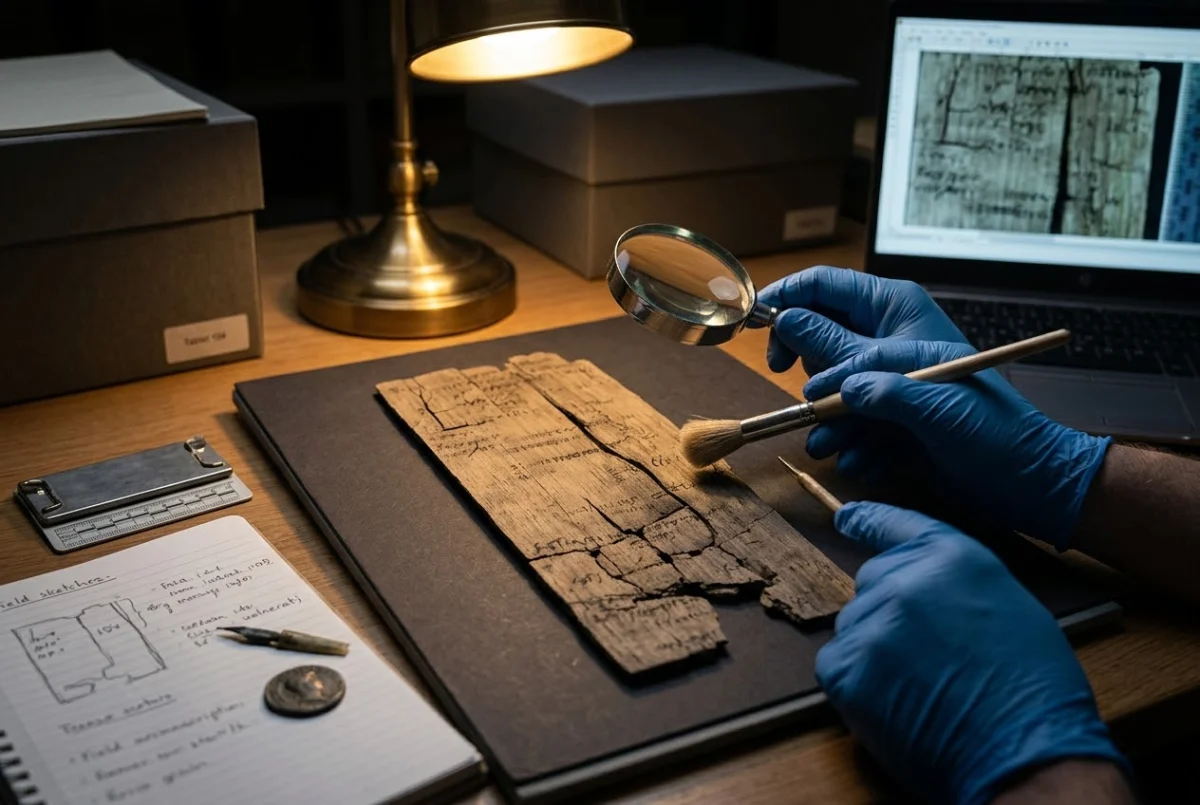
Buried beneath waterlogged clay, the Vindolanda strength tablet (cataloged by epigraphers as Tab. Vindol. 154) provides an unfiltered morning roll call from roughly AD 90 to 105. Written in ink across wafer-thin wood, this operational audit reveals that Roman frontier garrisons were constantly stretched thin, plagued by illness, and scattered across regional outposts
The Frontier Before Hadrian’s Wall: The Stanegate Road Network
Decades before Emperor Hadrian ordered his stone rampart built across northern Britain, Rome secured its northern border through an interior network of turf-and-timber outposts. Following the campaigns of Gnaeus Julius Agricola into Caledonia during the early AD 80s, the imperial high command consolidated control south of the Cheviot Hills.
The backbone of this early northern border was the Stanegate, an east-west military highway running from the River Tyne to the Solway Firth. Rather than a continuous stone barrier, this defense network relied on fortified troop stations situated roughly a day’s march apart.
Vindolanda stood at a vital geographic junction along this road. Situated in the valley of the Brackies Burn, the fort defended supply lines, oversaw local Celtic farmsteads, and regulated tribal traffic moving north and south.
Life on the Stanegate was not defined by pitched legionary battles. Instead, auxiliary units conducted counter-insurgency patrols, collected grain requisitions, and defended isolated transport convoys from local guerrilla bands.
                  [Caledonian Tribes / North]
                              │
  ════════════════════════════╪════════════════════════════  (Frontier Line)
  [Corbridge] ─── (Stanegate) ─── [Vindolanda] ─── (Stanegate) ─── [Carlisle]
                              │
                  [Brigantes Territory / South]
Discovery of the Leaf Tablets in the Peat
For centuries, historians studied Roman military operations almost entirely through imperial propaganda, monumental stone inscriptions, and elite literary accounts penned in Rome. The discovery of the Vindolanda tablets by archaeologist Robin Birley in 1973 upended classical scholarship.
Unlike Mediterranean records, which used wax tablets or imported Egyptian papyrus, the commanders at Vindolanda used local materials. Scribes shaved native birch and alder into paper-thin leaves, inscribed them with carbon-based ink using metal dip pens, and folded them shut like diptychs to protect the text.
The preservation of these fragile wooden leaves was a rare biochemical accident:
-
Anaerobic Burial Layers: Deep layers of discarded organic rubbish, bracken, straw, and horse dung were sealed under damp, oxygen-depleted clay layers.
-
Microbial Prevention: Without oxygen, standard decomposition halted completely, keeping wood fibers, leather shoes, and plant resins intact for nearly two millennia.
-
Routine Incineration Attempts: When units received reassignment orders, garrison clerks attempted to burn their filing cabinets in bonfire pits. Damp conditions extinguished these fires, leaving hundreds of administrative records baked into the protective mud.
Among these administrative fragments lay Tab. Vindol. 154, an official morning strength report (renuntiatio) detailing the operational readiness of the auxiliary unit holding the outpost.
Dissecting the Vindolanda Strength Tablet: Theory versus Reality
The central value of the Vindolanda strength tablet is its contrast between administrative troop strengths and field readiness. On paper, Roman military doctrine dictated structured cohort establishments, but the ledger compiled for the garrison commander, Julius Verecundus, presents a far different operational picture.
The unit under his command was the First Cohort of Tungrians (Cohors I Tungrorum), an infantry auxiliary formation originally recruited from Belgic Gaul. While organized on paper as a double-strength unit (cohors milliaria), its field ledger tells a sobering logistical story:
Total Registered Unit Strength (Paper Establishment): 752 men (including 6 centurions)
│
├── Present at Vindolanda Fort: 296 men
│     ├── Fit for Active Duty: 265 men
│     └── Sick / Wounded / Impaired: 31 men
│           ├── Sickness (aegri): 15 men
│           ├── Eye Disease (lippientes): 10 men
│           └── Combat/Work Wounds (volnerati): 6 men
│
└── Detached on Remote Deployment: 456 men
      ├── Corbridge Detachment: 337 men (including 2 or 3 centurions)
      ├── London (Governor's Guard/Bureaucracy): [Detached personnel]
      └── Scattered Logistical & Escort Duties: [Remaining balance of personnel]
These recorded numbers show that less than 40 percent of the registered personnel were physically present inside the base walls. Even more telling, only 265 soldiers—roughly 35 percent of the nominal establishment—were fit to strap on armor and man the ramparts if an attack came.
Centurion leadership was equally fractured. Out of six senior tactical commanders assigned to keep unit discipline, only one centurion was present with the garrison at the time of the morning report. The remaining five were scattered on detached service across the province.
Where Were the Missing Soldiers?
A sudden loss of more than 450 soldiers from a single fort might suggest disastrous battlefield casualties or mass desertion. The tablet, however, reveals the heavy administrative demands of holding an active province.
The missing soldiers were assigned to various remote duties throughout Britannia:
Garrison Outposts and Fortress Construction
The largest contingent, totaling 337 men, was stationed at Coria (modern Corbridge), sixteen miles east along the Stanegate. Corbridge served as the central logistical depot for the central frontier, where troops processed grain, forged weapons, and manufactured equipment.
Other small detachments garrisoned signal towers, bridge crossings, and defensive redoubts along the road, preventing local tribal confederacies from cutting line communications.
Provincial Bureaucracy in London
Selected soldiers were assigned south to Londinium to serve on the staff of the provincial governor. Roman provincial administration was tiny by modern standards, lacking a separate civil service.
Governors used auxiliary troops as imperial couriers (beneficiarii), bodyguards (singulares), tax monitors, and judicial clerks. This practice pulled seasoned fighters from frontline duties into long-term desk jobs hundreds of miles away.
Supply Chains, Herding, and Raw Materials
A Roman military outpost consumed vast quantities of raw material daily. Auxiliary soldiers were dispatched to secure timber from local oak forests, quarry freestone for hearths and drainage culverts, and gather peat for heating barracks.
Parties also guarded cattle herds, rounded up horses for cavalry remounts, and protected grain trains moving from the southern plains.
Health and Medical Realities: The Sick Roll
The Vindolanda strength tablet provides rare clinical insight into ancient military healthcare. Rather than romanticizing battle wounds, the tablet’s medical register notes the mundane ailments that degraded fighting units.
Of the thirty-one men listed as unfit for active duty, fifteen suffered from general illness (aegri), ten suffered from inflamed eye conditions (lippientes), and six were recovering from physical wounds (volnerati).
Total Medically Unfit: 31 Soldiers
┌─────────────────────────┬─────────────────────────┬─────────────────────────┐
│     Sickness (Aegri)    │    Eye Disease (Lippi)  │     Wounded (Volnerati) │
│         15 Men          │         10 Men          │          6 Men          │
│   (48% of sick roll)    │   (32% of sick roll)    │   (20% of sick roll)    │
└─────────────────────────┴─────────────────────────┴─────────────────────────┘
The high rate of eye inflammation reflects northern frontier life. Soldiers lived inside low, unventilated timber barracks, where open peat fires smoked continuously against the damp Atlantic weather.
Continuous exposure to soot, wood smoke, windborne dust, and bacterial infection caused chronic conjunctivitis and trachoma. These eye ailments rendered archers and spear-throwers ineffective for distance combat.
Combat and occupational injuries were also a constant reality:
-
Work Injuries: Quarrying stone, felling trees, and building defensive turf walls caused broken bones, herniated discs, and crushed limbs.
-
Local Skirmishing: Frontier duty involved chasing cattle thieves and suppressing ambushes along the road network.
-
Sanitation Pressures: While Roman forts featured latrines, clay pipes, and freshwater aqueducts, living in close quarters alongside draft animals facilitated the spread of dysentery and respiratory infections.
The fort’s hospital (valetudinarium) required medical supplies, clean linen, and healthy soldiers reassigned to act as nursing staff, further thinning the operational line.
Logistics, Equipment, and the Frontier Economy
Holding a border post required continuous supply work. Auxiliary troops received standardized equipment, though it varied from the heavy plate armor worn by the legions.
Tungrian auxiliaries wore flexible iron chainmail shirts (lorica hamata) constructed from alternating rows of stamped and riveted rings. This armor resisted cuts from Celtic slashing swords, but it required daily maintenance with sand and vinegar to prevent rust in the damp British climate.
They carried flat, oval wooden shields (clipei) banded with iron and were armed with thrusting spears (hastae), auxiliary short swords (gladii), and leaf-bladed daggers (pugiones).
             [Frontline Auxiliary Equipment]
┌───────────────────────┬─────────────────────────────────────────────────┐
│ Defensive Body Armor  │ Lorica Hamata (Iron chainmail, 20–25 lbs)       │
│ Shield Construction   │ Laminated birch/alder oval shield, iron boss    │
│ Primary Weapons       │ Hasta (Thrusting spear) & Spatha/Gladius        │
│ Personal Footwear     │ Caligae or heavy one-piece leather boots (Carbatinae) │
└───────────────────────┴─────────────────────────────────────────────────┘
The records recovered from the site prove that frontier garrisons did not live on hardtack alone. Procurement accounts detail purchases of cured bacon, vintage wine, Celtic beer (cervesa), sour wine vinegar (posca), fish sauce (garum), garlic, and salt.
Local native communities were drawn into the Roman economic orbit, supplying wool, hides, and grain to meet compulsory military levies. When supply convoys were delayed by winter weather or damaged bridges, garrisons scrambled to source feed for cavalry mounts, leading to food shortages.
The administrative burden of managing these shipments fell directly onto the camp prefect and his clerical staff, who logged every delivery on wooden tablets.
The Administrative Engine Behind Imperial Control
The central lesson of the Vindolanda documents is that Rome held its provinces through administrative organization rather than brute force alone. The empire did not station hundreds of thousands of troops across every contested borderland.
Instead, it relied on a lean administrative system that balanced dynamic detachments, logistics, and personnel rosters:
Tactical Mobility through Detailed Accounting
Commanders monitored their personnel daily. If a rebellion broke out near Corbridge, regional legates knew exactly how many men were already stationed at the depot, which roads were usable, and which units could march without leaving redoubts undefended.
Ruthless Recordkeeping
Every transaction, promotion, disciplinary action, and medical excuse was documented. This administrative discipline prevented local commanders from inflating unit payrolls, misplacing weapons, or losing accountability during combat deployments.
Psychological Deterrence
To local Celtic tribes, the Roman military appeared everywhere at once. Patrols rotated through river crossings, supply trains traversed paved roads, and fortified bases crowned dominant hilltops.
The natives rarely realized that behind the wooden palisade of forts like Vindolanda, only a few hundred able-bodied men were actually present to defend the gates.
       [Central Military Command Hub]
                     │
         (Daily Morning Ledger: Renuntiatio)
                     │
    ┌────────────────┼────────────────┐
    ▼                ▼                ▼
[Ration Ledger]  [Sick Roll]  [Security Patrols]
    │                │                │
    └────────────────┬────────────────┘
                     ▼
  (Imperial Stability with Modest Troop Counts)
The Human Experience Behind the Epigraphy
Beyond numbers and combat tables, the writing tablets preserved at Vindolanda reveal the human details of frontier garrison life:
-
Family Life: Officers brought their households to the edge of the world. One tablet preserves a birthday invitation from Claudia Severa to Sulpicia Lepidina, wife of the prefect Flavius Cerialis, representing the earliest known handwriting by a woman in Latin.
-
Everyday Comforts: Ordinary soldiers wrote letters home begging their families to send wool socks, thick undergarments, and sandals to survive northern winters.
-
Cultural Perceptions: Clerks wrote of the local British tribesmen as Brittunculi—”wretched little Britons”—reflecting the casual arrogance of imperial occupiers.
These documents bridge two thousand years, transforming names on stone markers into real human beings. The soldiers holding northern Britain were not unyielding statues. They were cold, homesick soldiers nursing eye infections, worried about missing pay, and hoping their relief detachment arrived on time.
The Vindolanda strength tablet strips away centuries of romantic mythmaking. It shows an empire sustained not by effortless martial dominance, but by logistical grit, administrative discipline, and soldiers who held the line against harsh climates and constant troop shortages.
Frequently Asked Questions
What is the Vindolanda strength tablet?
The Vindolanda strength tablet (cataloged as Tab. Vindol. 154) is a preserved wooden military record discovered at the Roman fort of Vindolanda in northern England. Dated between AD 90 and 105, it records a morning roll call for the First Cohort of Tungrians, documenting nominal unit strength, active duty numbers, detached assignments, and soldiers sidelined by sickness or wounds.
Why were writing tablets preserved at Vindolanda?
The tablets survived due to anaerobic soil conditions. When soldiers abandoned and rebuilt successive timber forts, organic debris, bracken, and turf were packed under thick, waterlogged clay. This sealed out oxygen, preventing bacteria and fungi from breaking down the fragile alder and birch wood sheets.
What does the tablet reveal about Roman military readiness?
The document proves that frontier garrisons operated far below their paper establishment. Out of 752 listed soldiers in the First Cohort of Tungrians, only 296 were physically present at the fort, and just 265 were healthy enough for active duty. The rest were detached across regional logistics hubs, assigned to provincial administrative desks, or recovering in the fort’s medical hospital.