
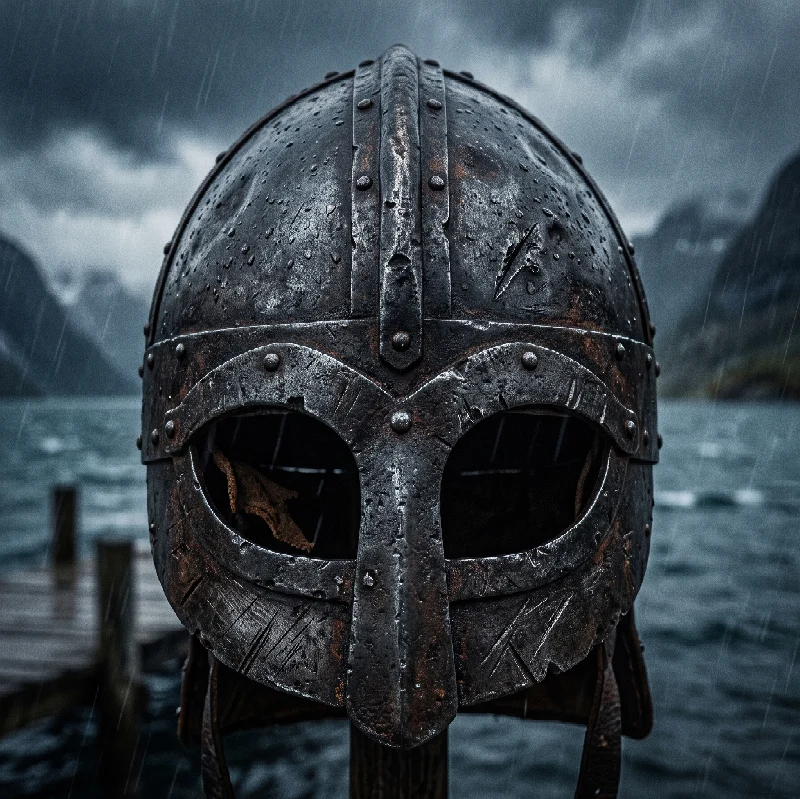
Viking Horned Helmets Myth: The Real Combat Archaeology
The Viking horned helmets myth remains one of the most enduring fabrications in modern historical memory. Popular culture routinely envisions a Norse raider materializing through sea spray, brandishing a broadaxe beneath a pair of menacing curved horns. This dramatic silhouette dominates cinema, sporting iconography, graphic novels, and festival wear.
Archaeological excavation across thousands of Scandinavian, British, and Slavic burial sites tells a completely different story. Field researchers have unearthed thousands of iron swords, axe heads, split-wood round shields, and riveted mail shirts. They have not discovered a single battle helmet bearing horns from the Norse early medieval period.
The dramatic headpiece familiar to modern audiences is an invention born from theatrical romanticism rather than authentic combat gear. The Viking horned helmets myth gained traction centuries after the last Norse longship struck sail. Real medieval Scandinavian combat demanded pragmatic gear built for survival, where unnecessary ornamentation meant swift death.
The Gjermundbu Find and Authentic Norse Headgear
For generations, antiquarians scoured northern Europe for physical evidence of the warrior headwear celebrated in romantic art. In 1943, on a farm in Ringerike, Norway, excavators recovered a damaged tenth-century cremation burial. Known as the Gjermundbu find, this burial produced the only complete, battle-ready helmet securely dated to the Viking Age.
The artifact looks nothing like the dramatic creations of modern entertainment. The headpiece was built for brutal hand-to-hand engagements, emphasizing structural integrity and simplicity.
-
Dome Construction: Four curved iron plates forged together with exterior iron bands and secured with low-profile dome rivets.
-
The Spectacle Guard: A distinct iron mask riveted to the brow, protecting the eyes and the ridge of the nose without limiting peripheral vision.
-
Base Reinforcement: A circular brow band featuring small pierced holes designed to anchor a dangling mail aventail protecting the neck.
-
Surface Profile: A smooth, convex iron shell entirely devoid of horn sockets, rivets for crests, or external decorative brackets.
The engineering of the Gjermundbu find directly contradicts the Viking horned helmets myth. Every millimeter of its surface reflects functional protection rather than theatrical intimidation.
The Lethal Physics of Early Medieval Combat
To a trained Norse warrior, wearing protruding horns into an infantry engagement would have proved suicidal. Scandinavian warfare relied upon the tightly packed shield wall, known as the skjaldborg. Within these close ranks, warriors fought shoulder-to-shoulder, overlapping lime and pine boards to present an unbroken barrier against arrows, throwing spears, and heavy axe blows.
In this claustrophobic environment, protruding horns would have repeatedly fouled the shields and spears of neighboring comrades. More dangerously, horns violate fundamental principles of armor ballistics:
-
Deflection Geometry: A smooth, hemispherical dome encourages downward sword cuts and heavy axe blows to glance off harmlessly across the shoulders.
-
Rotational Force: A weapon striking an outward-curving horn creates an inescapable kinetic lever, snapping the cervical vertebrae of the wearer with immense torque.
-
Weapon Traps: Horns catch incoming spear tips and the rims of opposing shields, allowing an enemy to wrench a warrior’s head downward and expose the unarmored throat.
Norse raiders were professional combatants who understood functional survival. Subscribing to the Viking horned helmets myth ignores the tactical brilliance that enabled Scandinavian warbands to dominate river systems and coastal zones from Ireland to the Black Sea.
The Logistical Constraints of Norse Longships
The spatial realities of seafaring made decorative headgear impossible. Norse longships, such as the famous skeid and drakkar vessels excavated at Roskilde, measured between twenty and thirty meters long with narrow beams. Between fifty and eighty crew members lived, ate, and worked in these open, un-decked wooden hulls for weeks across stormy waters.
Rowers sat close together on sea chests, pulling oars in unison for hours through heavy swells. Elaborate projections on headwear would constantly catch on rigging lines, stays, sailcloth, and passing oars. Elite warriors placed a premium on compact equipment that packed easily beneath rowing benches.
The physical demands of sea raids required durable, stripped-down gear. To examine how Scandinavian forces operated these mobile marine expeditions, see our analysis on [Internal Link: Viking Longship Construction and Navigational Tactics]. The pragmatic realities of naval warfare left no room for the clumsy headgear seen in the Viking horned helmets myth.
19th-Century Romanticism: The Operatic Origin of the Lie
If historical Scandinavian warriors never wore horned helmets in battle, who created this image? The fiction originated not in medieval sagas, but in the opera houses and artistic academies of nineteenth-century Europe. The Viking horned helmets myth was manufactured by Romantic nationalists who wanted to construct a dramatic ancestral past.
During the 1870s, German composer Richard Wagner prepared the premiere staging of his operatic cycle, Der Ring des Nibelungen, at the Bayreuth Festspielhaus in 1876. Costume designer Carl Emil Doepler was tasked with outfitting ancient Germanic and Norse deities, including Wotan and Brünnhilde.
Doepler sought visual devices that would instantly convey primal ferocity, divine majesty, and untamed northern strength to audiences watching from distant theater balconies. He looked toward uncontextualized archaeological finds recently recovered from peat bogs across northern Europe. Drawing loose inspiration from artifacts that predated the Norse era by thousands of years, Doepler fitted his performers with horned and winged headgear.
The Bayreuth production was an international cultural phenomenon. Illustrated newspapers, touring theater troupes, and painters quickly reproduced Doepler’s costume designs. Within three decades, the operatic wardrobe crossed into school primers, popular historical novels, and advertising posters, establishing the Viking horned helmets myth as accepted fact.
Confusing the Eras: The Bronze Age Veksø Artifacts
The archaeological prototypes that inspired nineteenth-century illustrators were real, but they had nothing to do with the medieval Scandinavian seafaring culture. In 1942, peat cutters working in a bog near Veksø, Denmark, recovered two bronze helmets sporting curved horns resembling the horns of oxen.
Radio-carbon testing and stylistic analysis confirmed that the Veksø helmets date to roughly 900 BCE—the Nordic Bronze Age. This places their creation nearly two millennia before the Viking Age began:
-
Veksø Production Date: Circa 1000–900 BCE (Late Nordic Bronze Age).
-
Viking Age Boundaries: Circa 793–1066 CE (Early Medieval Period).
-
Chronological Gap: Approximately 1,700 to 1,900 years between the artifacts.
-
Construction Material: Thin, cast and repoussé bronze designed for ritual display, offering negligible defense against iron striking weapons.
-
Intended Function: Religious regalia worn by ritual shamans during agricultural ceremonies, never infantry combat.
Nineteenth-century antiquarians frequently lumped millennia of prehistoric and medieval artifacts into a single heroic timeline. This lack of chronological precision fueled the Viking horned helmets myth, projecting ancient religious bronzes onto early medieval sea raiders.
The Reality of Iron Economics in the Viking World
Modern analysis of early medieval metallurgy helps explain why combat helmets were exceptionally rare throughout the North Sea world. Iron smelting relied on bog iron extracted laboriously from peat deposits. Purifying this ore required massive amounts of charcoal, bloomery furnaces, and days of intensive blacksmithing.
A simple iron axe head or spear tip required minimal iron and served dual purposes as agricultural tools and lethal weapons. An iron helmet demanded exceptional craft skill:
-
Dozens of pounds of raw bog iron ore to yield enough refined metal.
-
Multiple days of skilled forge work by an armorer to maintain uniform plate thickness.
-
Precise rivet fabrication to prevent plates from splitting under heavy shock loads.
Consequently, an iron helmet like the one from Gjermundbu was a status symbol owned by jarls, royal retainers, and elite warlords. The vast majority of rank-and-file raiders relied on heavy wool caps, thick leather headwear, or no head protection at all. The notion that hundreds of raiders wore iron headpieces adorned with costly metal horns is an economic impossibility, further undermining the Viking horned helmets myth.
Authentic Offensive and Defensive Norse Equipment
Historical battle gear achieved an elegant balance between mobility, shock value, and pragmatic defense. Norse raiders favored equipment designed for lightning amphibious assaults and rapid tactical retreats.
-
The Round Shield: Measuring between 70 and 90 centimeters in diameter, constructed from joined boards of lime, fir, or pine. The exterior was faced with rawhide to prevent splitting, while an iron boss protected the central handgrip.
-
The Ulfberht Sword: Pattern-welded and crucible steel broadswords averaging 80 to 95 centimeters in length, featuring wide fullers designed to shave weight without sacrificing blade rigidity.
-
The Dane Axe: Two-handed poleaxes with wide cutting edges measuring up to 30 centimeters across, mounted on ash hafts over a meter long. In trained hands, this weapon could cleave mail armor and shatter shield bosses with a single blow.
-
The Riveted Mail Shirt (Byrnie): Composed of tens of thousands of alternating punched and riveted iron links, providing defense against slashing sword blades and arrows.
The lethal simplicity of this arsenal reveals how disconnected the Viking horned helmets myth is from historical combat. A warrior equipped with a Dane axe and an unyielding iron dome needed functional agility, not ornamental liabilities.
[Typical Norse Combat Loadout: Tactical Profile]
Shield: 70–90 cm circular lime-wood board with central iron boss
Primary Hand-to-Hand: 80–90 cm single or double-edged pattern-welded sword
Shock Weapon: 1.2–1.5 m two-handed bearded or Dane axe
Missile Defense: Riveted iron mail shirt (byrnie) worn over thick wool gambeson
Headgear: Smooth four-plate iron dome with spectacle nasal guard (elite only)
To explore how these weapons performed against Anglo-Saxon and Frankish defenses, read our detailed breakdown of [Internal Link: The Great Heathen Army’s English Campaigns].
The Persistent Visual Seduction of Modern Pop Culture
Why does the Viking horned helmets myth continue to thrive despite decades of archaeological debunking? The answer lies in the psychological power of visual shorthand. Horns immediately transform a historical human being into an imposing barbarian caricature, separating the Norse from other early medieval cultures.
Hollywood cinema, video game designers, and sports franchises continue to rely on this imagery because it instantly signals strength, brutality, and pagan myth. A rounded iron helmet with a nose guard looks practical and authentic, but it lacks the menacing silhouette audiences expect.
Reclaiming historical truth does not diminish the legacy of the Norse people. Stripping away the theatrical horned helmet reveals a society far more complex than simple caricatures suggest. They were exceptional mariners, meticulous navigators, sophisticated legal thinkers, and skilled craftspeople who crossed the North Atlantic in open wooden vessels.
The Viking horned helmets myth reduces a remarkable maritime culture to an operatic trope. By understanding the genuine artifacts pulled from Scandinavian soil, we honor the genuine ingenuity, resourcefulness, and martial discipline of historical Norse warriors.
Frequently Asked Questions
Did Vikings ever wear horned helmets into combat?
No, historical Vikings never wore horned helmets in battle. Archaeological excavations across hundreds of Norse burial mounds have uncovered thousands of weapons and armor components, but zero combat helmets with horns. Real combat required smooth, rounded helmets to deflect incoming sword blows and axe strikes.
Where did the myth of Viking horned helmets originate?
The myth originated in the 1870s during the staging of Richard Wagner’s opera cycle, Der Ring des Nibelungen, at the Bayreuth Festspielhaus. Costume designer Carl Emil Doepler drew inspiration from ancient Bronze Age ceremonial artifacts and added horns to Norse costumes to make the characters look wild and imposing on stage.
What did authentic Viking helmets actually look like?
The only complete Viking Age helmet discovered—the tenth-century Gjermundbu helmet from Norway—features a smooth, rounded iron dome made of four riveted plates. It has a protective iron spectacle mask around the eyes and nose, but no horns, crest mounts, or external ornamentation.