
Achaemenid Empire: The Universal Hegemony of Ancient Persia
In the sixth century BCE, an imperial power arose from the Iranian plateau that fundamentally redefined human statecraft. The rise of the Achaemenid Empire shattered the cruel paradigms of earlier Near Eastern monarchies. Before its emergence, kingdoms such as the Assyrians and Neo-Babylonians governed conquered lands through mass deportation, terror, and systematic cultural erasure.
The Achaemenid Empire replaced that predatory doctrine with administrative tolerance, continental infrastructure, and logistical precision. At its territorial zenith under Darius I, this universal superpower governed an estimated forty-four percent of the global population, spanning from the Indus River to the Balkan fringes and down into the fertile Nile Valley.
The Rise of Cyrus II: Forging a Continental Superpower
The foundation of the Achaemenid Empire originated through the audacity of Cyrus II, remembered by posterity as Cyrus the Great. Originating from the regional kingdom of Anshan, Cyrus organized an alliance between Persian clans and the ruling Median aristocracy. In 550 BCE, his forces overthrew Astyages, absorbing the Median domains into a unified Iranian realm.
Rather than executing Median officials, Cyrus integrated them into administrative and military commands. This precedent established the multi-ethnic ethos of the Achaemenid Empire. Next, Cyrus turned west toward Anatolia, confronting King Croesus of Lydia. At the Battle of Thymbra in 547 BCE, Persian tactical flexibility dismantled the formidable Lydian cavalry, incorporating the wealthy Greek coastal cities into the imperial orbit.
The climax of Cyrus’s reign occurred in 539 BCE with the capture of Babylon. Rather than subjecting the Mesopotamian metropolis to fire and plunder, Persian troops marched into the city without resistance. Cyrus presented himself as the legitimate deliverer chosen by the Babylonian god Marduk, bringing an end to Nabonidus’s unpopular rule.
To formalize his policy of institutional clemency, Cyrus issued a clay barrel inscription known as the Cyrus Cylinder. This artifact recorded royal decrees ending the Babylonian captivity of displaced peoples, including the Judean community, and funded the restoration of regional temples. Through this visionary approach, the early Achaemenid Empire transformed conquered populations into willing partners in imperial governance.
The Satrapy System: Administrative Genius and Royal Oversight
Governing millions of subjects across three distinct continents demanded an administrative architecture unlike anything previously witnessed. King Darius I codified this structure by dividing the Achaemenid Empire into approximately twenty governed administrative provinces known as satrapies.
Each satrapy was governed by a royal appointee termed a satrap, selected from Persian nobility or local royal houses:
-
The Satrap’s Portfolio: The governor oversaw civil justice, maintained public roads, suppressed banditry, and guaranteed the collection of annual silver or gold bullion taxes assessed against imperial land surveys.
-
Separation of Civil and Military Powers: To prevent ambitious satraps from staging regional insurrections, garrison commanders in provincial citadels answered directly to the Great King rather than to the civil governor.
-
The Eyes and Ears of the King: Traveling royal inspectors toured the provinces unannounced, backed by mobile military retinues to audit treasury ledgers, review judicial rulings, and ensure compliance with royal edicts.
-
Standardized Currency and Legal Codes: Darius introduced the high-purity gold daric and silver siglos, establishing a uniform monetary baseline that fostered commerce across international borders.
Through this balanced hierarchy, the Achaemenid Empire preserved regional customs, legal traditions, and religious rites. A subject in Memphis lived under Egyptian sacred law, while a merchant in Babylon settled contracts through traditional cuneiform jurisprudence.
Administrative authority [Internal Link: Imperial Bureaucracy in Antiquity] was maintained because provincial populations recognized that imperial taxation guaranteed personal safety, public order, and unhindered regional trade.
Logistical Mastery: The Royal Road and Strategic Mobility
The sheer geographic scale of the Achaemenid Empire made rapid communication an operational imperative. To bind his territories together, Darius constructed the Royal Road, an engineering feat spanning over 1,600 miles from the administrative capital of Susa to the Aegean trade hub of Sardis.
The highway was leveled, cleared of obstructions, and maintained with continuous stone paving across fragile mountain passes. Along its route stood 111 royal staging posts, known as chapar khaneh, positioned at intervals corresponding to a single day’s ride:
-
Each station housed fresh mounts, armed guards, and royal messengers ready to relay dispatches.
-
Messengers rode day and night without interruption, carrying written scrolls along the entire 1,600-mile artery in seven days.
-
Greek historian Herodotus marveled at this postal network, remarking that neither snow, rain, heat, nor darkness could check the swift completion of their appointed rounds.
-
Armed military patrols secured intermediate road sections, turning formerly dangerous caravan trails into safe commercial corridors.
The transit infrastructure of the Achaemenid Empire extended far beyond simple courier transit. It enabled the rapid mobilization of standing garrisons and royal armies. An imperial army stationed in Media could redeploy along the Royal Road to crush a rebellion in Anatolia or Egypt before local insurgents could organize defensive fortifications.
Maritime logistics expanded in parallel. Darius completed the Canal of the Pharaohs, linking the Nile River directly to the Red Sea, enabling merchant ships to navigate from the Mediterranean to the Persian Gulf without unloading cargo overland.
Military Hardware and the Ten Thousand Immortals
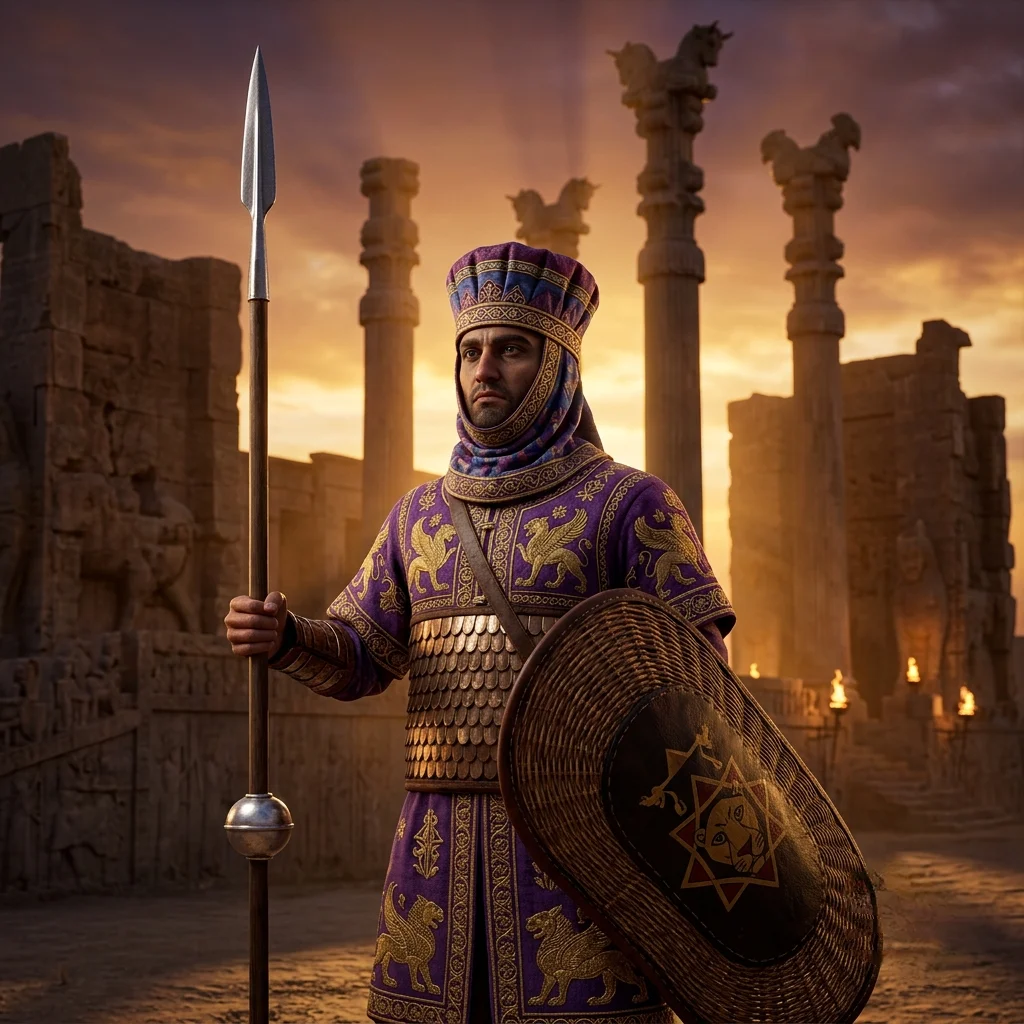
The tactical core of the Persian armed forces was the Athanatoi, an elite standing brigade known to the classical world as the Ten Thousand Immortals. This elite formation served as the royal guard in peace and the shock infantry vanguard in war. Their name derived from a strict organizational rule: if any member died, fell ill, or suffered severe injury, a veteran was immediately promoted into the ranks, maintaining the corps at an unchanging strength of exactly ten thousand men.
The equipment of the Immortals reflected the tactical doctrine of the Achaemenid Empire, prioritizing versatility and sustained missile combat:
-
Akinakes: A double-edged iron short sword measuring forty to forty-five centimeters, carried in an ornate scabbard suspended from a leather waist belt for close-quarter infighting.
-
Sagaris: A pointed iron battle-axe capable of splitting helmets and punching through bronze body armor.
-
Composite Recurve Bow: A powerful weapon composed of laminated horn, wood, and sinew, accompanied by quivers carrying thirty to forty reed arrows with socketed bronze three-bladed points.
-
Gerron: A tall, rectangular woven wicker shield faced with hardened ox-hide, light enough to carry on long marches while effective at absorbing opposing missile fire.
-
Concealed Scale Armor: Interlocking bronze or iron scales laced to leather backings, worn beneath richly dyed and embroidered tunics to deflect slashing strikes.
In open field engagements, the Achaemenid Empire utilized combined-arms tactics based on ranged suppression. Front-rank spearmen (sparabara) drove their wicker shields into the soil to erect an impenetrable defensive palisade. From behind this screen, thousands of archers discharged continuous, coordinated volleys that smothered enemy lines beneath clouds of iron and bronze.
Once opposing formations fragmented under missile attrition, Persian heavy cavalry—riding armored Nisean warhorses and armed with throwing javelins and slashing sabers—struck the disrupted flanks to complete the rout.
Tactical Vulnerabilities: Clashing with Western Phalanxes
Despite its unmatched operational success across the Near East, the military system of the Achaemenid Empire struggled when confronted by the rigid, bronze-armored infantry of the Aegean world. The Persian model prioritized open maneuvers, mobile skirmishing, and long-range archery—tactics optimized for the arid, expansive plains of Asia.
When Persian armies pushed across the Aegean into mainland Greece during the campaigns of Darius and Xerxes, the physical environment turned against them:
-
Narrow coastal defiles, muddy fields, and rocky ravines neutralized cavalry maneuvers and constricted deployment frontages.
-
The light wicker gerron was engineered to absorb lightweight arrows, but splintered under the crushing impact of heavy ash spears wielded by Greek hoplites.
-
Persian archers required open sightlines and space, which evaporated when tightly packed hoplite phalanxes charged across short distances at a run.
-
The short Persian spear was easily outdistanced by the nine-foot Greek thrusting lance (dory).
These technological disparities yielded decisive defeats for the Achaemenid Empire at Marathon in 490 BCE and Plataea in 479 BCE. At Plataea, the Persian commander Mardonius led his personal guard of Immortals with exceptional courage, yet their light armor and shorter spears could not penetrate the heavy bronze wall of the Spartan phalanx.
Persian strategists adapted rapidly by recruiting thousands of Greek mercenary hoplites into their standing armies. By the fourth century BCE, Greek heavy infantry formed an indispensable core within the operational doctrine of the Achaemenid Empire.
The Engineering Feats of Xerxes: Bridges and Canals
When Xerxes I launched his massive expedition against the Greek mainland in 480 BCE, the scale of military mobilization challenged the engineering limits of antiquity. The expeditionary host of the Achaemenid Empire was an amphibious coalition numbering hundreds of thousands of combatants supported by twelve hundred Phoenician, Egyptian, and Ionian warships.
To transport this colossal assembly across natural obstacles without relying on unpredictable sea crossings, Persian engineers executed two monumental public works:
-
The Hellespont Pontoon Bridges: Imperial engineers anchored 674 galleys and triremes across the one-mile strait between Abydos and Sestos. Wrapped with massive flax and papyrus cables, timber roadways were laid across the ship hulls, covered in packed earth, and flanked by high brushwood fences to keep horses from panicking at the water.
-
The Mount Athos Canal: To avoid the treacherous waters off the Mount Athos peninsula, where a storm had wrecked a Persian fleet in 492 BCE, Xerxes ordered Phoenician and local laborers to excavate a canal two kilometers long and broad enough for two triremes to row abreast.
These ambitious achievements illustrated the administrative reach of the Achaemenid Empire. When a sudden storm destroyed the first attempt at the Hellespont crossing, Xerxes executed his head engineers, placed new technicians in charge, and finished the pontoon bridges within weeks.
Logistical planning [Internal Link: Classical Persian Weaponry and Tactics] ensured that massive supply depots at Tyrodiza, Doriscus, and Therme kept this diverse army provisioned throughout its European campaign.
The Splendor of Persepolis: Architectural Manifestation of Imperial Harmony
Nothing expressed the political philosophy of the Achaemenid Empire more vividly than the ceremonial capital of Persepolis (Takht-e Jamshid). Founded by Darius I in the rugged Fars heartland, the city was built upon a vast stone terrace measuring 125,000 square meters, hewn into the base of Mount Rahmat.
Unlike contemporary Assyrian palaces, whose carved stone orthostats revelled in graphic depictions of flayed captives, blinded kings, and impaled prisoners, Persepolis broadcasted an entirely different imperial ideology:
-
The Apadana Reliefs: Monumental staircases carved from local limestone depicted delegations from twenty-three subject nations marching peacefully toward the royal audience hall.
-
Cultural Diversity: Sculptures displayed Babylonians, Medes, Armenians, Bactrians, Nubians, and Ionians wearing their traditional dress, carrying indigenous weapons, and bearing voluntary tribute gifts of horses, textiles, vessels, and frankincense.
-
The Gate of All Nations: Colossal winged bulls with human heads (lamassu) guarded the grand entry staircase, welcoming foreign envoys into an empire that framed itself as the protector of universal peace.
-
Paid Professional Labor: The Persepolis Fortification Tablets, a discovery of tens of thousands of Elamite clay administrative records, prove that the palaces were not constructed by enslaved captives, but by skilled, salaried craftspeople of both genders who received grain, wine, and silver wages.
Persepolis served as the cosmic center of the Achaemenid Empire, the gathering point for the annual Nowruz New Year celebrations. Here, the Great King reaffirmed the sacred covenant between Ahura Mazda, the Persian monarchy, and the peaceful nations of the known world.
Archaeological Discoveries: The Persian Empire in the Dirt
The material reality of the Achaemenid Empire has been illuminated through modern scientific excavations across Iran, Mesopotamia, and Egypt. The clay administrative records found within the Persepolis treasury provide an unparalleled look into everyday bureaucratic management.
Archaeological discoveries confirm the extraordinary fiscal precision of imperial scribes:
-
Tribute Accounting: Tablets document the exact weight of silver tribute sent from provinces, recording purity tests conducted by royal assayers.
-
Ration Distributions: Ledgers record maternal leave allowances, travel rations for royal couriers, and wine rations issued to foreign stonemasons working on palace column capitals.
-
The Oxus Treasure: A spectacular hoard of gold and silver metalwork discovered near the Tadjik border, featuring miniature gold chariots, intricate armlets terminating in winged griffins, and gold plaques depicting Persian nobles bearing ritual barsom bundles.
At Pasargadae, the tomb of Cyrus the Great survives as a dignified stone monument standing atop a six-tiered limestone plinth. Its simple, unadorned geometry contrasts sharply with the ostentatious sepulchers of Egyptian pharaohs, mirroring the austere, rugged ethos of early Persian kingship.
These artifacts demonstrate that the Achaemenid Empire was not a fragile political facade held together by fear, but an institutional network anchored by legal contracts, fiscal records, and enduring architectural landmarks.
Geopolitical Aftermath: The Enduring Blueprint of Empire
The political collapse of the Achaemenid Empire came swiftly between 334 and 330 BCE. The Macedonian king Alexander the Great, exploiting operational genius and the shock power of his companion cavalry, defeated Darius III at the Granicus, Issus, and Gaugamela.
Following the capture of the imperial capitals, Alexander ordered the torching of Persepolis in 330 BCE. The conflagration destroyed centuries of royal archives, an act widely interpreted as symbolic vengeance for the burning of the Athenian Acropolis 150 years earlier.
Yet while the Achaemenid dynasty fell, the administrative infrastructure of the Achaemenid Empire proved immortal:
-
The Hellenistic Synthesis: Alexander adopted the Persian court ceremonial, satrapal divisions, and the Royal Road system to govern his conquered territories, marrying his officers to Persian noblewomen.
-
The Seleucid and Parthian Succession: The Seleucid kingdom and the subsequent Parthian Arsacid dynasty retained the administrative, fiscal, and logistical blueprints developed by Darius I.
-
The Sasanian Empire: The Sasanians consciously revived Achaemenid heritage, restoring Zoroastrianism as the state faith and establishing an imperial rival that challenged the Roman Empire for four centuries.
-
Roman Imperial Adaptation: The Roman provincial system, complete with standardized governors, postal couriers, and legal integration of diverse ethnic communities, drew heavily from Hellenistic adaptations of Persian governance.
The Achaemenid Empire proved that vast, diverse populations could be governed through tolerance, infrastructure, and institutional competence rather than continuous violence. Long after its royal palaces fell into ruin, the administrative vision conceived by Cyrus and Darius remained the bedrock upon which future empires built the modern world.
Frequently Asked Questions
What was the historical significance of the Cyrus Cylinder?
The Cyrus Cylinder is a baked-clay foundation deposit inscribed in Babylonian cuneiform following Cyrus the Great’s capture of Babylon in 539 BCE. It is widely recognized as one of the earliest declarations of human rights because it denounced religious oppression, allowed deported populations to return to their ancestral homelands, and restored local temples across the empire.
How did the satrapy system keep governors from rebelling?
The satrapy system checked regional rebellion by dividing provincial civil authority from military command. While the satrap managed local taxes, public works, and civil justice, military commanders in regional citadels answered directly to the Great King. Furthermore, imperial traveling inspectors known as the “Eyes and Ears of the King” conducted unannounced audits supported by royal troops.
Why did the military of the Achaemenid Empire struggle against Greek hoplites?
Persian armies struggled against Greek hoplites because their weapons and armor were optimized for open-field mobility and missile combat on broad Asian plains. When fighting in restricted European topography, light wicker shields, short iron spears, and quilted linen tunics were outmatched by heavy bronze body armor, nine-foot thrusting lances, and the interlocking mass of the Greek phalanx.