
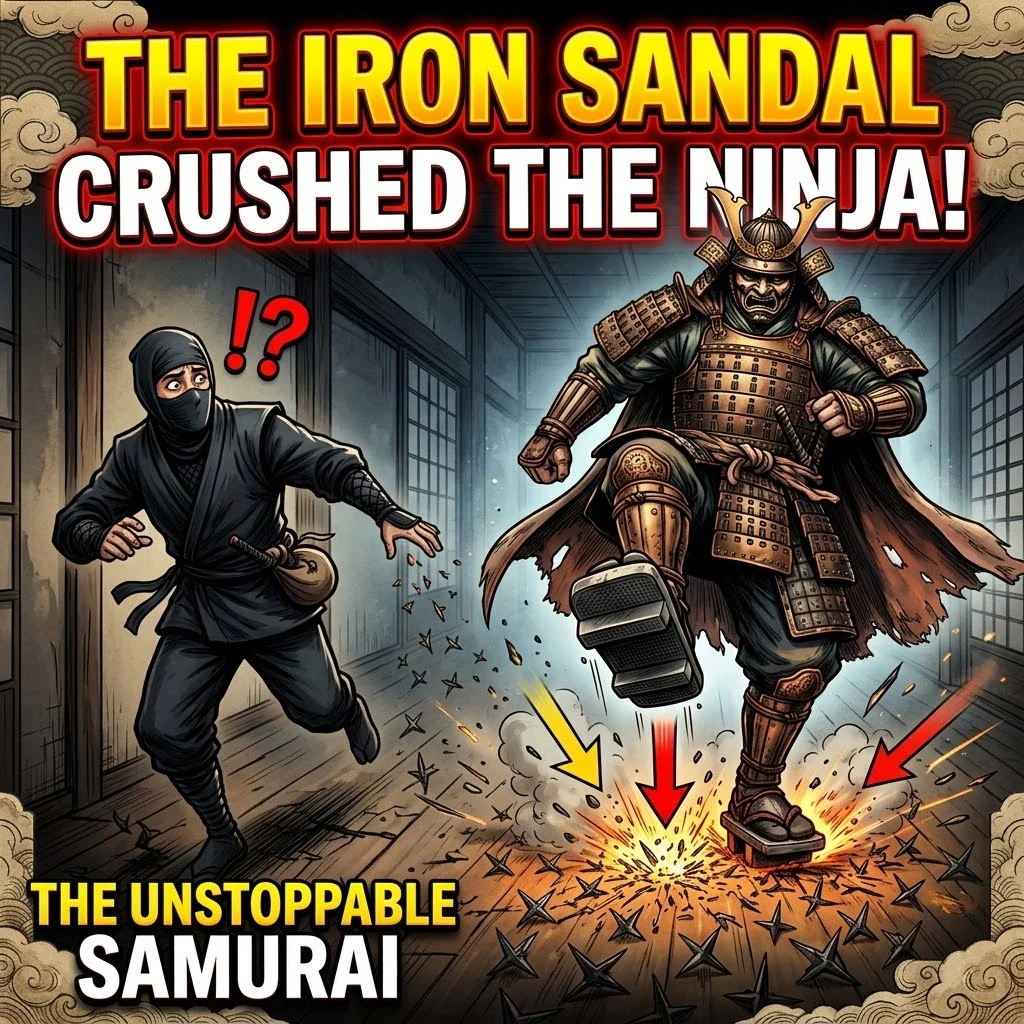
Tetsu-Geta Fumi: The Samurai Iron Sandal Countermeasure Against Shinobi Caltrops
Feudal Japan was an arena of asymmetrical warfare, where covert espionage collided with rigid military doctrine. Popular accounts routinely emphasize the covert exploits of shinobi infiltrators slipping through shadows, yet the defensive counters engineered by castle retainers were equally sophisticated.
Among these specialized techniques, Tetsu-Geta Fumi stands out as a masterclass in mechanical defense and psychological warfare. This battlefield response bypassed cautious evasion entirely, using heavy iron footwear to pulverize area-denial spikes underfoot and crush an infiltrator’s tactical escape plan.
The Sengoku Arms Race: Fortresses, Intrigue, and Asymmetrical Warfare
The Sengoku Jidai, or Warring States period, forced a radical transformation in Japanese castle design and close-quarters security. Regional warlords built massive fortresses like Azuchi and Osaka Castle, turning regional keeps into labyrinthine complexes designed to withstand both open siege and covert penetration.
As warlords fortified their perimeter walls with stone ramparts and gatehouses, covert espionage became the primary tool to destabilize rival domains from within. Shinobi operatives specialized in gathering intelligence, conducting arson, and eliminating commanders behind guarded walls.
Castles answered this threat with ingenious passive defenses. Night-watch architecture incorporated nightingale floors (uguisubari), whose metal brackets rubbed against nails beneath timber planks to create bird-like chirping whenever someone stepped on them.
Corridors were built narrow to restrict sword arcs, while low lintels forced attackers to stoop, exposing their necks to defenders. Inside these enclosed spaces, foot mobility decided survival. Infiltrators sought every advantage to impede the heavily armored retainers stationed within the keep.
The Threat of Tetsubishi: Stealth Area Denial
When an intruder tripped an alarm inside an inner ward, escape was a matter of seconds. Fleeing through dim, polished wooden hallways, an operative could not outrun fresh castle guards indefinitely.
To break pursuit, operatives deployed tetsubishi, the Japanese iron caltrop.
       ▲  (Upright Spikes)
      / \
     /   \
    /  ●  \  (Forged Core)
   /  / \  \
  ▲  ▲   ▲  (Always Lands Point-Up)
Forged from scrap iron or shaped from dried water caltrop seed pods (hishi), these four-pointed spikes were engineered with geometric certainty. Whichever way a caltrop struck the floor, one razor-sharp barb remained pointed directly upward.
The primary role of the caltrop was area denial:
-
Puncture Vulnerability: Standard samurai footwear consisted of straw sandals (waraji) or split-toe cloth socks (tabi), neither of which offered sole protection against tempered metal.
-
Toxin Delivery: Infiltrators regularly coated iron caltrops with natural toxins, snake venom, or horse manure, ensuring that even a shallow puncture would cause incapacitating infection or tetanus within hours.
-
Tactical Delay: The real purpose was psychological and temporal. A pursuer who stepped on a spike collapsed in agony, while those behind had to stop, illuminate the dark floor, and clear the corridor point by point.
By dropping a single handful of spikes along a narrow passage, an operative bought the critical minutes needed to reach an exterior wall and drop into the moat.
The Iron Fortress Below: Engineering the Tetsu-Geta
To neutralize ground hazards, elite castle guards and martial arts practitioners turned to tetsu-geta, or solid iron clogs.
In peacetime and standard training regimens, these iron sandals served as resistance equipment for martial artists and palace guards. Practitioners wore heavy clogs during basic movement drills to strengthen the calf muscles, hips, and core, instilling balance for wrestling in heavy armor (yoroi-kumiuchi).
Inside castle garrisons, these training tools formed a direct tactical countermeasure.
   ┌───────────────────────────┐  ◄── Thick Wrought-Iron Footbed
   │                           │
   └───┬───────────────────┬───┘
       │                   │      ◄── Twin Solid-Iron Supports (Ha)
       │   [Impact Area]   │
       ▼                   ▼
═══════════════════════════════════════  ◄── Hardwood Corridor / Spikes
A standard pair of wooden geta consisted of a timber platform elevated on two vertical wooden slats called ha (teeth). Tetsu-geta, by contrast, were forged entirely from solid iron or heavy bronze, weighing anywhere from five to over twenty pounds per foot depending on their specific operational role.
The construction of these tactical iron clogs combined several distinct elements:
-
Forged Iron Baseplate: A flat iron platform shaped to support the warrior’s foot, thick enough to resist bending under hundreds of pounds of downward force.
-
Hardened Support Teeth: Two heavy transverse bars forged directly to the underside of the sole, elevating the foot two to three inches above the floor.
-
Reinforced Cord Rigging: Heavy braided hemp or leather cords secured the iron platform to the foot, ensuring the heavy weight would not tear loose during aggressive forward lunges.
When worn over standard tabi, these iron sandals transformed the lower limbs into living battering rams. Sharp metal spikes on the floor could not reach the skin through solid iron.
Tactical Mechanics of Tetsu-Geta Fumi
The term fumi translates directly to stepping, treading, or crushing underfoot. The martial maneuver known as Tetsu-Geta Fumi was the systematic destruction of ground hazards through forward momentum.
Rather than slowing down or picking their way through a compromised hallway, guards trained in this countermeasure accelerated their pace directly into the field of spikes.
[ Armored Samurai: ~180-220 lbs ]
             │
             ▼  (Forward Kinetic Drive)
[ Solid Iron Tetsu-Geta: ~10-20 lbs ]
             │
             ▼  (Mass Concentrated on Thin Iron "Teeth")
   ══════════╪══════════  (Extreme PSI Impact)
             ▼
[ Tetsubishi (Caltrop): Bent, Snapped, or Driven into Timber ]
When an armored retainer charged down a corridor, the physical mechanics shifted entirely in the defender’s favor. An average warrior in partial armor carried a combat weight between 180 and 220 pounds. Adding the mass of the iron footwear and channeling the kinetic energy of a forward sprint focused immense force through the narrow bottom edges of the iron teeth.
The physical interactions during the maneuver were decisive:
-
Direct Crushing Pressure: The structural integrity of a small iron caltrop could not withstand the downward force of iron striking iron. The points buckled, bent flat, or snapped entirely at the forge welds.
-
Timber Displacement: On wooden castle walkways, the sheer pressure drove the small metal spikes directly into the grain of the floorboards, embedding them flush with the wood and neutralizing their exposed tips.
-
Clearance of Natural Spikes: Natural dried water caltrops (tennen-tetsubishi) disintegrated instantly into harmless dust under the solid iron edges.
The technique required exceptional physical conditioning. Lifting and driving heavy iron clogs forward without losing center of gravity demanded deep core stability and explosive leg drive.
Retainers trained in Tetsu-Geta Fumi kept their stance low and their center of gravity planted, ensuring that each step landed with sufficient force to destroy hazards without throwing the warrior off balance.
Psychological Warfare in Close Quarters
The true tactical victory of Tetsu-Geta Fumi went beyond clearing obstacles; it shattered the opponent’s morale.
Infiltration tactics relied on predictability. A covert agent depended on the certainty that an iron caltrop would disable human flesh. Throwing spikes down a dark corridor gave the operative a mental safety buffer, creating the assumption that pursuers would halt, call for torches, or risk a crippled foot.
Seeing that assumption collapse in real time produced instant disorientation:
Breaking the Infiltrator’s Plan
The sound of iron teeth crashing into hardwood signaled an entirely different caliber of defender. Instead of the muffled thuds of straw sandals, the corridor echoed with metallic strikes and cracking wood.
An operative looking back would not see guards hesitating at the edge of the trap. They saw armored figures moving steadily forward, their footwear crushing the spikes into flattened iron scrap.
Escalating Pursuit Pressure
When defensive countermeasures failed, an operative’s escape window closed rapidly. The steady approach of an enemy who ignored physical traps forced the fleeing agent into rushed decisions, leading to mistakes, missed grappling points, or panicked confrontations against superior numbers.
Decisive Domination
In Japanese martial culture, psychological dominance (heihō) was prized as highly as physical victory. Neutralizing an opponent’s signature trap under iron heels demonstrated complete operational superiority. It transformed the defender from a reactive guard into an unstoppable physical force.
Armor, Metallurgy, and Defensive Logistics
The success of Tetsu-Geta Fumi reflected the advanced metallurgy of late medieval Japan. During the Sengoku period, iron production expanded rapidly to supply the massive demand for weapons, matchlock firearms (tanegashima), and plate armor (tosei-gusoku).
Smelting operations utilizing the tatara furnace produced high-carbon steel (tamahagane) for sword blades alongside softer, malleable wrought iron (hōchōtetsu).
This softer, shock-absorbent iron was ideal for defense equipment like the tetsu-geta. A brittle, high-carbon steel clog might fracture when striking iron caltrops at high speed, but wrought iron deformed slightly without shattering, absorbing the shock of impact while crushing the harder, thinner spikes underneath.
| Equipment Component | Primary Material | Tactical Purpose | Weakness / Trade-Off |
| Tetsubishi | Forged scrap iron or dried seed pods | Area denial, puncturing soft soles, delivering toxins | Crushed easily by heavy metal soles |
| Waraji | Woven rice straw | Lightweight traction, silent movement, low cost | Zero puncture resistance against spikes |
| Tabi | Layered cotton or deer hide | Split-toe dexterity, indoor mobility | Easily pierced by upward-facing spikes |
| Tetsu-Geta | Solid wrought iron with hemp rigging | Absolute sole protection, crushing downward force | High weight, reduced running speed, loud impact |
| Tosei-Gusoku | Lacquered iron plates with silk cord | Protection against slashes, arrows, and firearms | Substantial total combat weight (30-50 lbs) |
Logistically, maintaining specialized gear like iron footwear was restricted to central keeps and high-value garrisons. Castles kept racks of specialized equipment near guard barracks, including polearms (yari), man-catchers (sasumata), and heavy footwear for emergency defense.
The weight of tetsu-geta made them impractical for long-distance outdoor patrols, but within the restricted corridors of an inner palace, they served as a reliable counter to sudden infiltration.
The Martial Legacy of Tetsu-Geta Fumi
As the Tokugawa shogunate unified Japan in the early seventeenth century, the chaotic warfare of the Sengoku era gave way to an era of enforced peace. Castle garrisons no longer faced constant infiltration, and the need for immediate, brutal counters like Tetsu-Geta Fumi receded from regular military practice.
The equipment, however, found a permanent home in traditional Japanese martial arts (koryū bujutsu):
-
Conditioning Tools: Schools of jujutsu, karate, and traditional footwork (tai sabaki) preserved the use of tetsu-geta as staple conditioning weights. Martial artists wore them to build leg power, refine low stances, and develop balance.
-
Combat Philosophy: The principle underlying the caltrop crush survived within martial philosophy: when confronted by hidden hazards or deceptive tactics, move through them using superior physical preparation and decisive intent.
-
Tactical Documentation: Martial densho (instructional scrolls) continued to record defensive methods for clearing trapped pathways, reminding students that physical strength and simple mechanical solutions can dismantle complex covert weapons.
The legacy of Tetsu-Geta Fumi highlights the ongoing dynamic between covert operations and conventional defense in feudal Japan. For every hidden weapon developed to exploit a soldier’s vulnerability, samurai engineers devised a direct, physical countermeasure to reassert control over the battlefield.
Frequently Asked Questions
What does Tetsu-Geta Fumi mean in English?
Tetsu-Geta Fumi translates to “iron sandal stepping” or “iron clog treading.” In feudal Japanese martial practice, it describes using heavy, solid-iron sandals (tetsu-geta) to deliberately stomp down and crush ground hazards like caltrops (tetsubishi) during hallway pursuits.
Could tetsubishi pierce through standard samurai footwear?
Yes. Feudal Japanese warriors typically wore waraji (woven straw sandals) or tabi (split-toe cloth socks). Neither provided meaningful resistance against pointed iron spikes. Stepping on a caltrop in standard footwear resulted in immediate, deep puncture wounds that could be worsened by poison or bacteria on the metal.
Were tetsu-geta used for everyday walking?
No. Tetsu-geta were far too heavy for standard daily travel, often weighing between five and twenty pounds per shoe. They were used primarily as strength-training gear by martial artists to condition the legs and hips, or kept in castle armories as specialized gear for guards countering covert traps.