
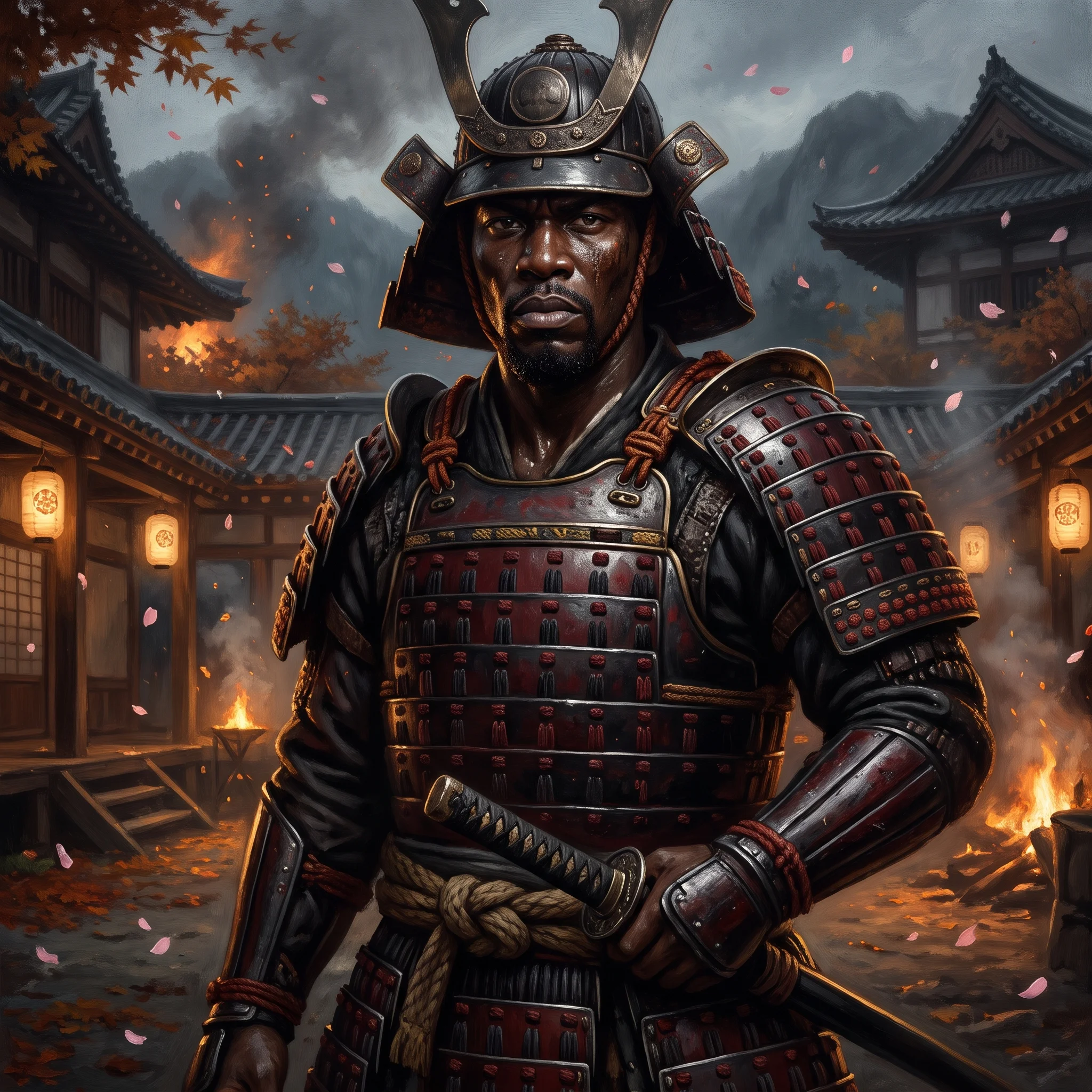
Yasuke: The True Story of Japan’s African Samurai
In the spring of 1581, the bustling streets of Kyoto ground to a halt. Crowds surged forward with such ferocity to catch a glimpse of a single man arriving at a Jesuit mission house that people were crushed against wooden walls, resulting in broken bones and severe injuries. The object of their astonishment was not an emperor, a victorious general, or a foreign ambassador. He was a towering, dark-skinned man from Africa who stood over six feet tall—nearly a full foot taller than the average sixteenth-century Japanese man—and possessed the rumored strength of ten warriors. Within months, this stranger would enter the inner circle of Japan’s most powerful warlord, receive his own residence, carry a ceremonial sword, and earn a place in history as Yasuke, the African samurai.
Few figures from feudal Japan have sparked as much fascination, debate, and mythmaking as Yasuke. While modern novels, anime, and video games have transformed him into an unstoppable mythic hero, the actual historical record is far more intriguing—and surprisingly well-documented. Drawn from contemporary Jesuit letters, Japanese chronicles, and the personal diaries of sixteenth-century nobles, Yasuke’s real journey spans continents, empires, and the bloodiest civil war in Japanese history.
Origins: From East Africa to the Seas of Asia
Before he became known as Yasuke in Japan, the man’s birth name, exact homeland, and early life vanished into the unrecorded margins of the sixteenth-century Indian Ocean trade network. Most historians agree that he originated from East Africa—likely modern-day Mozambique, South Sudan, or Ethiopia—regions heavily targeted by Portuguese slave traders and maritime merchants operating out of Goa, India.
During the 1570s, Yasuke entered the service of Alessandro Valignano, an influential Italian Jesuit priest appointed as the Visitor of Missions in the Indies. Valignano oversaw all Catholic missionary operations across Asia, from India to China and Japan. Rather than treating Yasuke merely as a manual laborer, Valignano utilized him as a bodyguard and valet. Travelling alongside a high-ranking European cleric across dangerous maritime routes required physical resilience, adaptability, and loyalty—qualities Yasuke clearly possessed in abundance.
In July 1579, Valignano’s ship docked at the port of Kuchinotsu in southern Kyushu, Japan. At the time, Japan was locked in the Sengoku Jidai—the Warring States period—a century-long era of relentless civil war in which regional warlords (daimyo) fought for supremacy over a fractured archipelago. Portuguese traders and Jesuit missionaries had arrived in Japan only three decades earlier, bringing firearms, European goods, and Christianity. Yet while the Japanese had grown accustomed to pale-skinned European merchants and priests, virtually no one in the country had ever seen a sub-Saharan African.
Wherever Valignano traveled, Yasuke became an immediate sensation. In Kyoto, the commotion caused by locals clamoring to see him grew so violent that spectators broke down the doors of the Jesuit residence just to peer inside. Word of the giant foreigner with skin like charcoal quickly reached the ears of the single most powerful man in Japan: Oda Nobunaga.
Meeting Oda Nobunaga: The Demon King’s Curiosity
Oda Nobunaga was no ordinary warlord. Ruthless, brilliant, and fiercely unconventional, Nobunaga had shattered centuries-old political and religious hierarchies to unify nearly half of Japan under his banner. Unlike traditionalist nobles who viewed foreign customs with suspicion, Nobunaga embraced European technology—most notably matchlock arquebuses—and frequently hosted Jesuit missionaries to learn about global geography, astronomy, and military engineering.
In March 1581, Nobunaga summoned Valignano and his entourage to his headquarters at Honno-ji temple in Kyoto. The moment Nobunaga laid eyes on Yasuke, he was captivated. According to the Shinchō Kōki—the official chronicle of Oda Nobunaga compiled by his retainer Ota Gyuichi—Nobunaga was initially convinced that the man’s dark skin must have been painted with black ink.
Nobunaga ordered Yasuke to strip to the waist and scrub his skin with water in front of the court. When the water ran clear and Yasuke’s skin remained unchanged, Nobunaga’s skepticism turned into genuine delight. Recognizing the value of having such an extraordinary figure in his retinue, Nobunaga hosted a celebratory banquet in Yasuke’s honor, gifting him a large sum of money on the spot.
Soon afterward, Valignano formally presented Yasuke to Nobunaga, entering him directly into the warlord’s service. Nobunaga bestowed upon him the Japanese name Yasuke—a phonetic adaptation likely derived from his original African name or a Portuguese rendering such as Yasufe.
Was Yasuke Truly a Samurai? Examining the Historical Evidence
One of the most fiercely debated questions among modern readers is whether Yasuke held the formal rank of a samurai or served merely as an exotic bodyguard. To answer this accurately, historians examine how the samurai class functioned during the late sixteenth century, before the rigid hereditary caste system of the Edo period was codified.
During the Sengoku period, the title of samurai was defined not solely by noble bloodline, but by service, stipends, and the right to bear arms for a lord. The historical evidence regarding Yasuke’s status comes from three primary sources:
-
The Shinchō Kōki (Chronicle of Lord Nobunaga): Ota Gyuichi explicitly records that Nobunaga granted Yasuke a private residence (yashiki), a regular stipend (fuchi), and a ceremonial katana. In feudal Japan, owning a residence and receiving a direct stipend from a daimyo were official markers of retainer (bushi) status.
-
The Diary of Matsudaira Ietada: In May 1582, Matsudaira Ietada, a vassal of Tokugawa Ieyasu, recorded meeting Yasuke in his personal diary (Ietada Nikki). Ietada described Yasuke’s height as roughly 6 shaku 2 sun (approximately 188 cm or 6 feet 2 inches) and noted that Nobunaga had officially made him a retainer (fuchi).
-
Jesuit Annual Letters (1581–1582): Father Luis Frois, a Portuguese Jesuit who knew Yasuke personally, wrote back to Europe that Nobunaga treated Yasuke with remarkable familiarity, frequently dining with him—an extraordinary honor reserved for trusted companions—and hinted that Nobunaga intended to elevate him to the status of a tono (a feudal lord).
Furthermore, Yasuke served as Nobunaga’s personal weapon-bearer (kosho), a prestigious position typically reserved for promising young warriors and trusted confidants who stood directly beside their lord both in court and on the battlefield. While Yasuke never commanded an army of his own, every historical benchmark of the 1580s confirms that he lived, fought, and was compensated as a legitimate samurai retainer.
Life at Azuchi Castle and the Warlord’s Inner Circle
Following his induction into the Oda clan, Yasuke traveled with Nobunaga to Azuchi Castle, Nobunaga’s magnificent hilltop fortress overlooking Lake Biwa. Azuchi was unlike any castle Japan had ever seen—a seven-story architectural marvel decorated with gold leaf, vibrant murals, and stone foundations designed to withstand siege warfare.
Within this glittering seat of power, Yasuke quickly adapted to Japanese courtly life. Contemporary Jesuit accounts note that he spoke Japanese remarkably well—likely aided by two years of immersion alongside missionaries—and possessed an engaging, intelligent personality that endeared him to Nobunaga. The warlord thoroughly enjoyed conversing with Yasuke, asking endless questions about Africa, India, and the lands Yasuke had crossed before reaching Japan.
For a ruler surrounded by scheming vassals, rival warlords, and political sycophants, Yasuke offered something priceless: an outsider completely detached from Japan’s internal clan rivalries. Yasuke owed his entire livelihood, status, and protection solely to Oda Nobunaga. In an era where betrayal was routine—a reality vividly reflected in the later Bushido Code: The 8 Virtues of the Feudal Samurai—unconditional loyalty was the rarest currency in the realm.
In early 1582, Yasuke marched alongside Nobunaga’s elite forces during the final campaign against the Takeda clan in Kai Province. It was during this campaign that Tokugawa vassal Matsudaira Ietada observed Yasuke walking proudly in Nobunaga’s vanguard, witnessing firsthand the African samurai’s imposing stature among Japan’s hardened veterans.
Betrayal at Honno-ji: Yasuke’s Final Stand
By June 1582, Oda Nobunaga stood on the brink of unifying Japan under his absolute rule. Preparing to launch a massive western campaign, Nobunaga paused in Kyoto with only a small retinue of roughly thirty pages, guards, and attendants—Yasuke among them—taking lodging at the Honno-ji temple.
Before dawn on June 21, 1582, the silence of Kyoto was shattered by the sound of marching boots and battle cries. Akechi Mitsuhide, one of Nobunaga’s most trusted generals, had turned traitor, surrounding the temple with an army of 13,000 soldiers.
Outnumbered more than four hundred to one, Nobunaga and his small guard fought desperately inside the burning temple complex. Nobunaga initially fired a bow until the string snapped, then fought with a spear before suffering a severe wound. Retreating into an inner chamber as flames engulfed the wooden halls, Nobunaga committed seppuku (ritual suicide) to prevent his head from falling into Akechi’s hands.
Yasuke survived the inferno at Honno-ji and immediately fought his way across Kyoto to join Nobunaga’s eldest son and heir, Oda Nobutada, who was rallying loyalist troops at nearby Nijo Castle. When Akechi’s overwhelming forces assaulted Nijo Castle later that morning, Yasuke stood alongside Nobutada’s defenders, fighting fiercely with his sword until the garrison was overrun and Nobutada was forced to take his own life.
Surrounded and exhausted, Yasuke finally surrendered his blade to Akechi Mitsuhide’s officers.
Aftermath and Legacy: Why Yasuke’s Story Endures
When Yasuke was brought before Akechi Mitsuhide, the usurper faced a decision. Rather than executing Yasuke alongside the other captured Oda retainers, Akechi dismissed him with cold contempt. According to Father Luis Frois, Akechi declared that Yasuke was “an animal who knew nothing, nor was he Japanese,” and ordered his soldiers to hand Yasuke over to the Jesuit church in Kyoto.
Though meant as a racial insult, Akechi’s dismissal saved Yasuke’s life. Eleven days later, Akechi Mitsuhide himself was defeated and killed at the Battle of Yamazaki by Toyotomi Hideyoshi—setting in motion the chain of succession struggles that would eventually culminate in the decisive Battle of Sekigahara: Inside the Clash That United Japan.
After Yasuke was returned to the Jesuit mission in Kyoto in late June 1582, he vanished completely from surviving historical records. Whether he remained in Nagasaki under Jesuit protection, returned to India aboard a Portuguese carrack, or lived out his days quietly in southern Japan remains one of history’s most intriguing open questions.
Yet in just fifteen months under Oda Nobunaga’s banner, Yasuke carved an indelible mark into world history. His life shatters the long-standing myth that feudal Japan existed in total isolation from the wider globe. Long before modern globalization, an East African warrior walked the corridors of Azuchi Castle, dined with the unifier of Japan, and fought to the bitter end in defense of his lord—standing alongside legendary figures like Miyamoto Musashi: 5 Brutal Truths of His Strategy and the loyal retainers of the 47 Ronin: True History of Japan’s Greatest Vendetta as proof that the spirit of the samurai transcended borders and bloodlines.
Quick Timeline of Yasuke in Feudal Japan
| Year | Historical Event |
| 1579 | Yasuke arrives in Kyushu, Japan, serving as bodyguard to Jesuit Visitor Alessandro Valignano. |
| March 1581 | Huge crowds gather in Kyoto to see Yasuke; Oda Nobunaga summons him to Honno-ji and tests his skin. |
| 1581 | Nobunaga inducts Yasuke into his service, giving him a residence, stipend, and ceremonial katana. |
| Spring 1582 | Yasuke marches with Nobunaga in the campaign against the Takeda clan; recorded in the Ietada Nikki. |
| June 21, 1582 | Yasuke fights at Honno-ji and Nijo Castle during Akechi Mitsuhide’s coup before being returned to the Jesuits. |
Frequently Asked Questions (FAQ)
1. Was Yasuke a real historical person? Yes. Yasuke is documented in multiple primary sixteenth-century sources, including the Shinchō Kōki (chronicle of Oda Nobunaga), the personal diary of samurai Matsudaira Ietada, and letters written by Portuguese Jesuit missionary Luis Frois in 1581 and 1582.
2. Did Yasuke actually hold the rank of samurai? Yes. During the Sengoku period, samurai status was defined by serving a warlord (daimyo), receiving a stipend, owning a residence, and bearing arms. Historical records confirm Nobunaga granted Yasuke all of these privileges and kept him in his personal retinue.
3. What happened to Yasuke after Oda Nobunaga died? Following the Honno-ji Incident in June 1582, Yasuke fought alongside Nobunaga’s son Oda Nobutada at Nijo Castle until he was captured. The traitor general Akechi Mitsuhide spared his life and handed him over to the Jesuit church in Kyoto, after which Yasuke disappears from historical records.